



Why Maternal Instinct Gender Prediction Works

Índice
- Why maternal instinct gender prediction works as a psychological effect
- What does science say about maternal instinct accuracy?
- Psychological explanations: why maternal instinct feels like it works
- Common myths and anecdotes about maternal instinct and gender
- How to embrace maternal instinct while relying on medical accuracy
- Key Takeaways
- My honest take on maternal instinct and pregnancy
- What Boy or Girl offers for gender prediction
- FAQ
- Recommended
Maternal instinct gender prediction is a psychological effect that feels highly accurate but performs close to random chance in controlled studies. Studies show maternal intuition correctly predicts baby’s gender about 51%–60% of the time. That range barely clears the 50% you’d get from a coin flip. Yet millions of expectant mothers swear their gut feeling was right. Understanding why maternal instinct feels so reliable, and where it actually falls short, helps you bond with your baby without placing false confidence in a guess.
Why maternal instinct gender prediction works as a psychological effect
Maternal instinct gender prediction, known in psychology as intuitive prediction, draws on subconscious pattern recognition rather than any biological signal about fetal sex. Your brain is constantly scanning for patterns, and pregnancy floods it with new sensations, emotions, and social cues. The mind assembles these inputs into a feeling of certainty, even when no reliable signal exists.
Medical professionals confirm no physiological mechanism allows intuition to detect fetal sex. That finding is critical. It means the feeling of “knowing” comes entirely from inside the mother’s mind, not from any physical information about the baby. The accuracy gap is stark: maternal instinct sits at 51%–60%, while medical tests reach 95%–99%.
Three forces drive the feeling of accuracy:
- Subconscious pattern recognition: Your brain links physical symptoms, dreams, and emotional shifts to gender stereotypes absorbed from culture. It then presents that link as a gut feeling.
- Confirmation bias: You remember the times your instinct was right far more vividly than the times it was wrong.
- Cultural reinforcement: Friends, family, and social media constantly validate the idea that mothers “just know,” which strengthens belief before any outcome is confirmed.
The result is a prediction that feels personal and certain but carries no more statistical weight than a random guess.
What does science say about maternal instinct accuracy?
The research picture is consistent and worth knowing before you place too much trust in your hunch. Accuracy levels range between 51% and 60%, with some small samples reporting up to 71% when researchers controlled for gender preference. That 71% figure sounds impressive, but it comes from small samples and has not been confirmed at scale.
Mothers who express strong intuition can reach 62%–70% accuracy in certain studies. Researchers note that confirmation bias and strong personal feelings likely drive that uptick, not a genuine predictive ability.
Here is how the main gender prediction methods compare:
| Method | Accuracy | Available From |
|---|---|---|
| Maternal instinct | 51%–60% | Any time |
| Ultrasound | 95%–99% | 18–22 weeks |
| NIPT (Non-Invasive Prenatal Testing) | 99%+ | 10 weeks |
| Old wives’ tales | Near 50% | Any time |
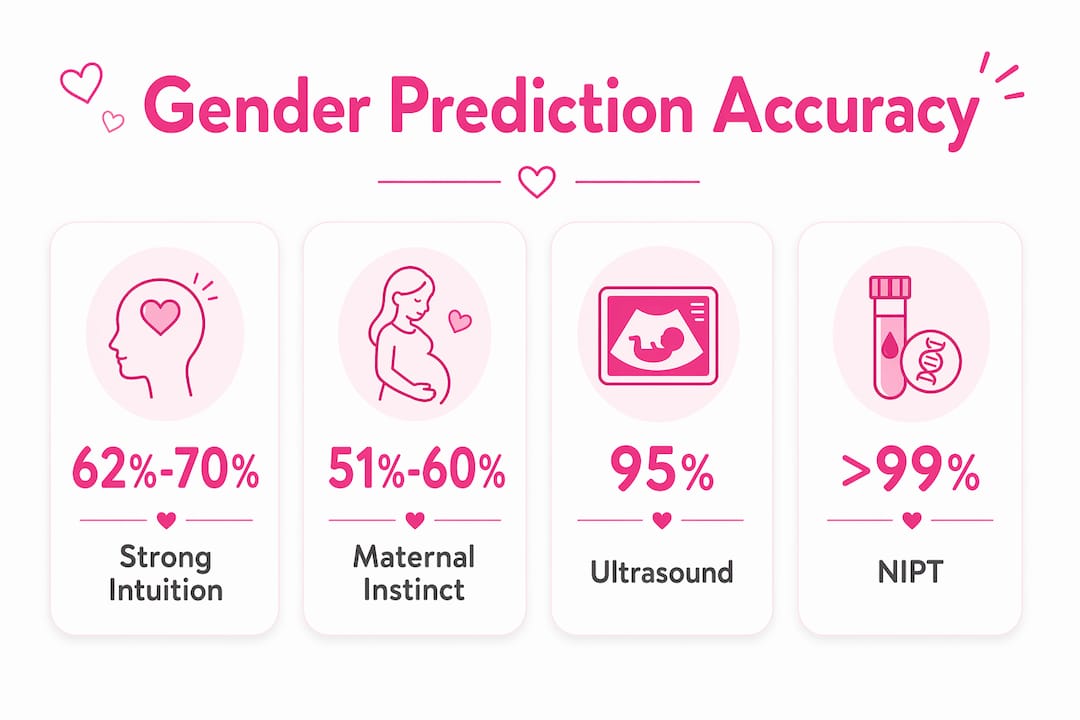
Ultrasound and NIPT remain the gold standards for fetal gender prediction. NIPT, available as early as 10 weeks, analyzes fetal DNA in the mother’s bloodstream and delivers results with over 99% accuracy. That is not a comparison maternal instinct can win.
Study limitations matter here. Most research on maternal intuition uses small, self-selected samples of mothers who already believe in their instinct. That design inflates accuracy numbers. Larger, controlled studies consistently pull the figure back toward 50%.
Psychological explanations: why maternal instinct feels like it works
Confirmation bias is the single biggest reason maternal intuition feels more accurate than it is. When your guess turns out to be right, the memory is vivid and emotionally charged. When it is wrong, the miss fades quickly. Over time, your mental record of “hits” grows while your record of “misses” shrinks. The result is a strong personal belief in your own predictive ability.
Subconscious pattern recognition adds another layer. Pregnancy brings dozens of physical and emotional changes: nausea patterns, energy levels, food cravings, sleep quality, and mood shifts. Your brain links these experiences to gender stereotypes learned over a lifetime. A strong craving for salty food, for example, gets mentally tagged as “must be a boy” because culture says so. The brain then presents that connection as intuition.

Cultural narratives about motherhood amplify both effects. Stories of mothers who “just knew” circulate constantly in parenting communities, on social media, and in family conversations. Cultural expectations create a social feedback loop that makes maternal instinct seem far more effective than data supports. You hear the success stories. You rarely hear about the mothers who were wrong.
Pro Tip: Keep a simple note on your phone recording your gender guess and the reasoning behind it. After birth, reviewing that note honestly, including the misses, gives you a clear picture of how confirmation bias works in real time.
Emotionally, maternal instinct serves a real purpose. Experts describe it as a psychological phenomenon that aids parental bonding rather than a biological predictor. The feeling of connection it creates is genuine and valuable, even when the prediction itself is not reliable.
Common myths and anecdotes about maternal instinct and gender
Old wives’ tales have surrounded pregnancy for centuries, and many of them get tangled up with maternal instinct. Folk methods like bump shape, food cravings, and fetal heart rate have no empirical backing, yet they remain culturally widespread. They persist because they give expectant parents a sense of participation and control during a time of uncertainty.
The most common myths include:
- Bump shape: Carrying high means a girl; carrying low means a boy. Bump shape depends on muscle tone, body type, and baby position, not fetal sex.
- Heart rate: A fetal heart rate above 140 beats per minute supposedly signals a girl. Research does not support this claim.
- Food cravings: Craving sweets means a girl; craving salty or savory foods means a boy. Cravings reflect nutritional needs and hormonal shifts, not gender.
- Skin changes: Dull skin supposedly means a girl “stealing your beauty.” Skin changes during pregnancy are driven by hormones, not the baby’s sex.
“Strong preference or desire can sometimes be confused with intuition, complicating self-assessments of prediction accuracy. Mothers with a strong gender preference may project their expectations as gut feelings, making it nearly impossible to separate what they sense from what they hope.”
Separating emotional gender preference from true intuition remains one of the hardest challenges in evaluating these claims. A mother who deeply wants a daughter and guesses “girl” is not demonstrating instinct. She is expressing hope. When that guess is correct, it gets added to the cultural story of mothers who “just knew.”
Anecdotal success stories persist for a simple reason: a 50%–60% accuracy rate still means millions of mothers guess correctly. Those mothers share their stories. The mothers who guessed wrong are less likely to broadcast the miss.
How to embrace maternal instinct while relying on medical accuracy
Maternal instinct has real value in pregnancy, just not as a prediction tool. Used correctly, it strengthens your emotional bond with your baby and makes the pregnancy experience richer. The key is knowing when to trust your feelings and when to trust your doctor.
Here is a practical approach:
- Use intuition for bonding, not betting. Let your gut feeling guide how you imagine and connect with your baby. Pick a name you love for each possibility. Decorate the nursery in a way that works either way. Enjoy the wondering.
- Schedule your anatomy scan. Ultrasound at 18–22 weeks gives you 95%–99% accuracy. That is the right moment to find out if you want to know the sex before birth.
- Ask about NIPT early. If you want to know sooner, NIPT is available from 10 weeks and delivers over 99% accuracy. It also screens for chromosomal conditions, giving you clinically useful information beyond gender.
- Notice if preference is driving your guess. If you have a strong wish for one sex, acknowledge it. That awareness helps you separate hope from instinct and keeps your expectations realistic.
- Share your instinct as a fun guess, not a fact. Tell your partner, your family, and your friends what you think, but frame it as a feeling, not a certainty. That framing protects everyone from disappointment if the scan says otherwise.
Pro Tip: Write a letter to your baby describing what you imagine them to be like, based purely on your instinct and feelings. It becomes a beautiful keepsake regardless of whether your gender guess was right.
Maternal instinct enriches the pregnancy experience by fostering excitement and emotional engagement. That is its real function. Medical tests handle the facts. Your instinct handles the feeling. Both have a place, and they work best when you keep them in their proper roles.
Key Takeaways
Maternal instinct gender prediction works as an emotional and psychological experience, not a reliable biological signal. Its accuracy sits near chance levels, while medical tests like NIPT and ultrasound deliver results above 95%.
| Point | Details |
|---|---|
| Accuracy near chance | Maternal instinct predicts gender correctly 51%–60% of the time, barely above a coin flip. |
| Confirmation bias inflates belief | Mothers remember correct guesses vividly and forget misses, making instinct feel more reliable than it is. |
| No biological mechanism exists | Medical professionals confirm no physiological pathway allows intuition to detect fetal sex. |
| Medical tests are far more reliable | Ultrasound (95%–99%) and NIPT (99%+) are the only methods that deliver accurate gender information. |
| Instinct supports bonding | Maternal intuition is most valuable as an emotional bonding tool, not as a prediction method. |
My honest take on maternal instinct and pregnancy
At Boy or Girl, we talk with expectant mothers every day, and the question of gender instinct comes up constantly. Here is what I have come to believe after years of working in this space: maternal instinct is real, but it is not what most people think it is.
The feeling of knowing your baby’s sex is genuine. It is not imaginary, and it is not silly. But it is a feeling generated by your mind, shaped by your hopes, your culture, and your deep desire to connect with the life growing inside you. That is beautiful. It just is not a diagnostic tool.
What concerns me is when expectant parents treat a gut feeling as a certainty and then feel genuinely shocked or disappointed when the ultrasound says otherwise. That disappointment is avoidable. Your instinct told you something real about your emotional state. It did not tell you something factual about your baby’s chromosomes.
The mothers I most admire during pregnancy hold both things at once. They enjoy their gut feeling as part of the experience. They also show up for their anatomy scan with open minds. They let the feeling and the facts coexist without one canceling the other out.
Trust your instinct to guide your connection. Trust your doctor to guide your decisions. That combination serves you and your baby far better than either one alone.
What Boy or Girl offers for gender prediction
Curiosity about your baby’s sex is one of the most exciting parts of pregnancy. Boy or Girl brings together the emotional and the evidence-based sides of that curiosity in one place.

The XY Method uses chromosomal prediction backed by clinical studies, giving you a science-grounded option that goes well beyond a gut feeling. It is designed for expectant mothers who want more than a guess but are not yet at their anatomy scan. Boy or Girl also offers personalized support, community forums, and expert resources so you never feel alone in the process. Pair your maternal intuition with a method that actually has the research behind it, and you get the best of both worlds: the emotional connection you feel and the accuracy you deserve.
FAQ
How accurate is maternal instinct at predicting baby’s gender?
Maternal instinct predicts baby’s gender correctly about 51%–60% of the time, which is close to random chance. Medical tests like ultrasound and NIPT are far more reliable, reaching 95%–99% accuracy.
Why do so many mothers feel certain about their baby’s gender?
Confirmation bias causes mothers to remember correct guesses and forget incorrect ones, creating a strong sense of accuracy over time. Cultural stories about mothers who “just knew” reinforce that belief further.
Can a strong gut feeling ever be a reliable gender predictor?
A strong gut feeling does not reliably predict gender because no physiological mechanism connects maternal intuition to fetal sex. Even mothers with very strong feelings only reach 62%–70% accuracy in the best-case studies, and confirmation bias likely explains much of that figure.
When can medical tests confirm my baby’s sex?
NIPT can confirm fetal sex from as early as 10 weeks with over 99% accuracy. Ultrasound becomes reliable at 18–22 weeks, with accuracy between 95% and 99%.
Is maternal instinct useful at all during pregnancy?
Maternal instinct is genuinely useful as an emotional bonding tool. Experts describe it as a psychological phenomenon that deepens parental connection, even though it does not reliably predict fetal sex.
Visita nuestras redes sociales
Recommended
Pregnancy Announcement Timing Examples: A Real Guide

Why Mobile-First Design Suits Pregnancy Platforms

Pregnancy Milestone Celebrations: Build Your Community

What Is a Pregnancy Wellness Platform? Your Guide

Mood Tracker for Pregnancy: Your 2026 Emotional Wellness Guide

Types of Pregnancy Online Communities: 2026 Guide